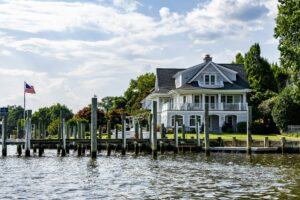
Who owns the beach lot in a Michigan lake community, and who is allowed to use a private road to reach it? Michigan lake access easement rights are usually decided by the recorded plat, the deeds, and the chain of title, not by decades of informal use. Property owners in Michigan lake communities often assume that decades of use determine who may use a private road, access a shared beach, or claim ownership of waterfront property.
In Matsen v Braun, unpublished per curiam opinion of the Michigan Court of Appeals, issued December 16, 2025 (Docket Nos. 367028 and 367029), the Court demonstrated why those assumptions can be wrong. The Court resolved competing claims to a strip of beachfront property, determined whether neighboring subdivision owners held irrevocable easement rights, and decided whether landlocked property owners could access their property by traveling over private subdivision roads under the doctrine of easement by necessity. Although the dispute arose in a platted subdivision, the decision provides important guidance for condominium associations, homeowners associations, lake associations, and waterfront property owners throughout Michigan.
The Matsen v Braun Lake Access Easement Dispute
The dispute arose between property owners in two neighboring subdivisions located on Indian Lake in Schoolcraft County. The Indian Lake Sunset Beach subdivision (“Sunset Beach subdivision”) is a 141-lot platted community created in 1937 and recorded in 1946. Its recorded plat dedicated the subdivision’s streets, alleys, beach park, and playground to the use of the lot owners.
Bernice Matsen and Edward Marsh owned lots within Sunset Beach, south of Parcel H, while Christopher Orr and Kathleen Kerrigan owned lots north of Parcel H and later intervened in the lawsuit.
Across a public highway lies Lake Haven Estates, a separate 14-lot subdivision. In 1984, the subdivision’s developers, William and Lorrie Bowman, recorded a notice stating their intent to convey a one-fourteenth ownership interest in Parcel H to each purchaser within Lake Haven Estates. The Bowmans later completed those transfers through recorded deeds, resulting in the Lake Haven Estates owners collectively holding fee title to Parcel H.
The dispute centered on Parcel H, a narrow 15-foot-wide strip of waterfront property connecting Indian Lake to Sunset Beach Drive. Although the Lake Haven Estates owners held fee title to Parcel H, it was landlocked and could only be accessed by traveling on private roads within the Sunset Beach subdivision.
The Sunset Beach owners argued that the Lake Haven Estates owners had no right to use those private roads; certain intervening owners went further, disputing the Lake Haven Estates owners’ ownership of Parcel H itself. The trial court granted summary disposition in favor of the Lake Haven Estates owners, and the Michigan Court of Appeals affirmed.
Who Owns Lake Access Property in a Michigan Subdivision?
One of the primary issues in Matsen v Braun was whether the Sunset Beach subdivision owners held ownership rights in Parcel H or merely the right to use it. Orr and Kerrigan argued that the 1946 plat dedication prevented the developers of Lake Haven Estates from later conveying ownership interests in Parcel H to the Lake Haven Estates owners.
The Michigan Court of Appeals disagreed. The Court explained that Parcel H had its own separate and traceable chain of title, beginning with the Indian Lake Company, passing to the Cardiffs, then to the developers of Lake Haven Estates, and ultimately to the Lake Haven Estates owners through a series of recorded deeds. At no point was Parcel H conveyed as part of the Sunset Beach subdivision itself.
The Court relied on longstanding Michigan precedent, including Thies v Howland, 424 Mich 282; 380 NW2d 463 (1985), Little v Hirschman, 469 Mich 553; 677 NW2d 319 (2004), Redmond v Van Buren County, 293 Mich App 344; 819 NW2d 912 (2011), Morse v Colitti, 317 Mich App 526; 896 NW2d 15 (2016) and Dobie v Morrison, 227 Mich App 536, 540; 575 NW2d 817 (1998) to conclude that the 1946 plat created a nonexclusive irrevocable easement rather than fee ownership. Because Parcel H remained a separately titled parcel throughout its chain of title, the Lake Haven Estates owners retained fee title while the Sunset Beach owners possessed only easement rights. Before assuming that a subdivision, lake association, homeowners association, or condominium association owns a beach lot, roadway, or access parcel, review the recorded plat, deeds, and chain of title.
Can a Property Owner Claim Exclusive Rights to a Lake Access Easement?
Orr and Kerrigan alternatively argued that even if the plat created an easement, it was exclusive and prevented the Lake Haven Estates owners from using Parcel H.
The Court disagreed. Relying on Penrose v McCullough, 308 Mich App 145; 862 NW2d 674 (2014), the Court reiterated that Michigan courts generally will not imply an exclusive easement unless the governing document expressly provides for one. Because the Sunset Beach plat contained no such language, the Court held that the easement was nonexclusive. If a subdivision, lake association, or group of owners intends to prohibit others from using a lake access easement, the governing documents should expressly state that the easement is exclusive.
Can a Property Owner Acquire Lake Access Property Through Adverse Possession?
As a fallback position, Orr and Kerrigan argued that they had acquired ownership of Parcel H through adverse possession. The Court disagreed. Citing Cove Creek Condominium Association v Vistal Land & Home Development, LLC, 330 Mich App 679; 950 NW2d 502 (2019), Rozmarek v Plamondon, 419 Mich 287; 351 NW2d 558 (1984), Kipka v Fountain, 198 Mich App 435; 499 NW2d 363 (1993) and Beach v Lima Township, 283 Mich App 504; 770 NW2d 386 (2009), the Court concluded that Orr’s mowing, stick removal, and routine use of Parcel H were consistent with the existing easement and therefore could not satisfy the hostility requirement necessary to establish adverse possession. Long-term use that is consistent with an existing easement generally will not establish ownership by adverse possession.
Can Property Owners Use Private Roads to Reach Landlocked Lake Property?
The central dispute involved whether the Lake Haven Estates owners could use Sunset Beach’s private roads to reach Parcel H. Applying Charles A. Murray Trust v Futrell, 303 Mich App 28; 840 NW2d 775 (2013), Chapdelaine v Sochocki, 247 Mich App 167; 635 NW2d 339 (2001), and Schmidt v Eger, 94 Mich App 728; 289 NW2d 851 (1980), the Court concluded that Parcel H became landlocked when it was severed from the surrounding property and held that the Lake Haven Estates owners therefore possessed an easement by necessity over the Sunset Beach subdivision’s private roads. Because their use of the roads was authorized, the Court also affirmed dismissal of the trespass claim.
Before restricting a neighboring property owner’s use of a private road, boards and lake associations should determine whether historical common ownership created an implied easement by necessity, even if no recorded easement appears in the chain of title.
Key Takeaways on Michigan Lake Access Rights for Community Associations
Matsen v Braun is an important reminder that Michigan courts look first to recorded plats, deeds, and governing documents when resolving disputes over ownership and access rights. Assumptions about ownership and access in lake communities are often incorrect, and courts will enforce the parties’ recorded property rights rather than informal understandings or historical practice.
- Pre-1968 plat dedications generally create easement rights rather than ownership rights. A subdivision may have the right to use a beach lot, access parcel, or roadway without actually owning the underlying property.
- Language dedicating property “to the use of” lot owners generally creates an easement rather than fee ownership. Before assuming a community owns lake access property, review the recorded plat, deeds, and chain of title.
- Michigan courts generally will not find an exclusive easement unless the governing documents expressly provide for exclusivity. If a subdivision or lake association intends to exclude others from a shared access parcel, the documents must say so explicitly.
- Long-term use of lake access property that is consistent with an existing easement generally will not establish ownership through adverse possession. As Matsen illustrates, routine activities such as lake access and minor maintenance may not satisfy the hostility requirement.
- Landlocked lake access parcels may carry implied easement rights over neighboring private roads. Before blocking a neighboring owner’s road use, investigate whether a shared ownership history creates an easement by necessity.
- A valid easement may defeat a trespass claim. When an easement exists, the relevant question is whether the easement holder exceeded the scope of the easement.
What Michigan Lake Communities Should Do Now
If your subdivision, lake association, condominium association, or homeowners association includes private roads, shared beach lots, waterfront access parcels, or other common areas that were created decades ago, now is the time to review your recorded plat, deeds, and governing documents. As Matsen v Braun demonstrates, the right to use property and the right to own property are not always the same, and landlocked property owners may possess implied access rights even when no express easement appears in the recorded documents.
Proactively reviewing your community’s recorded documents and chain of title before a dispute arises can help avoid costly litigation and provide clarity regarding ownership, easement rights, and access to private roads and waterfront property. If your Michigan condominium association, homeowners association, lake association, or subdivision community needs guidance regarding easement rights, lake access disputes, plat dedications, or private road issues, the experienced Michigan real estate attorneys at Hirzel Law, PLC can help.